
Critical Essay: The Subtle Politics of "Piku"
Why the Shoojit Sircar directorial is, truly, a film for the ages.

[Warning: This article contains spoilers for “Piku.”]
Comfort. So much of our actions can revolve around comfort. The want of it. The love of it. It’s the reason so many of us turn to entertainment. And even more often it’s the reason we abhor politics.
Corporations and studio houses on both sides of the political spectrum keep pushing their idea of good politics through their product. It sometimes feels like it’s been pushed down your throat. That’s not exactly a comfortable notion.
Let’s be honest: no one likes being lectured. Being told what is right and what is wrong. To a giant chunk of audiences, entertainment means detachment. For two shining hours, you could forget all your problems. All your mistakes. All the things wrong with society. So, people often ask creatives and storytellers to remain apolitical in their work.
But really, what great art has ever been apolitical?
Subtlety is the name of the game. It’s how you bring up the tiny and giant imperfections in society so that audiences come to your conclusions by themselves. Subtlety, I’ve come to realize, works well with comfort. Works wonders, really.
So when you create the cinematic equivalent of warm soup on a winter’s night with a dash of subtle politics, what do you get?
Alas, thy answer is Piku.
The first visual of Piku is its title: bold white letters on a background of black while the sarod plays in the background. The modern monochromatic look is disturbed only by a red dot on the ‘i’. This shade of red is unmistakably vermillion, an important color in Indian culture. It is the same color of bindi with which Piku Banerjee adorns her forehead. Vermillion is also the mark of a married woman and a traditional happy married life.
But nothing about Piku’s story is remotely traditional.
Most filmmakers in India when making a “female-led” movie, as it’s known here, portray their protagonists as urban, modern, kind, and bucking cultural gender roles. However, Shoojit Sircar crafts Piku as a modern woman with traditional undertones. While Piku wishes to get married soon, her father Bhaskor strenuously objects. He considers marriage without purpose “low-IQ behavior”. The dynamic between Piku and her father, both overbearing characters, forms much of the crux of the plot.
Piku refuses to play by the rules Bollywood enforces on its leading ladies. Piku Banerjee is brash, short-tempered, and frustrated. She treats drivers poorly and often loses her cool with strangers. But Sircar and screenwriter Juhi Chaturvedi never villanize her. Played by superstar Deepika Padukone, it’s easy to think of her as nothing but a movie character. Throughout the film, Piku is seen eating food. It’s a tiny detail, but it enforces that she is only human. We see her play with her hair, sit on a shopping mall cart, and eat an ice cream. She plays badminton. She’s religious. She’s a Satyajit Ray aficionado.
Piku Banerjee is not a traditional Hindi film protagonist.

Cinematographer Kamaljeet Negi positions Padukone in crowded frames, almost as if the paraphernalia in her world is meant to overwhelm her. But Piku is a representation of the eldest Indian child, one burdened with responsibilities.
Piku is exasperated by her father, who constantly pushes his opinions onto her. Bhaskor, a hypochondriac, continually gets himself tested. When they all turn up negative, he’s genuinely disappointed. For a man who is trying to prolong his life at all times, he unconsciously seems to be ready to pass. Speaking of passing, his struggle with constipation sets the stage for much-needed comedy. The subplot also allows the entry of multiple supporting characters. The theme of “passage” also finds its way into the film, which doubles as a road-trip film from Delhi to Kolkata, and later in the form of Bhaskor’s demise.
Joining Piku and Bhaskor on their road trip is Rana, a newly unemployed civil engineer now running a taxi service. Rana is a perfect example of reversing gender roles. In typical Bollywood romances, the heroine enters the hero’s life at a pivotal point and changes it for the better. Here, legendary actor Irrfan plays the gender-swapped catalyst Rana. A man who also struggles with an overpowering mother, his issues mirror Piku’s. Rana’s arrival and his dealing with Bhaskor give Piku a different opinion on managing her father’s idiosyncrasies.
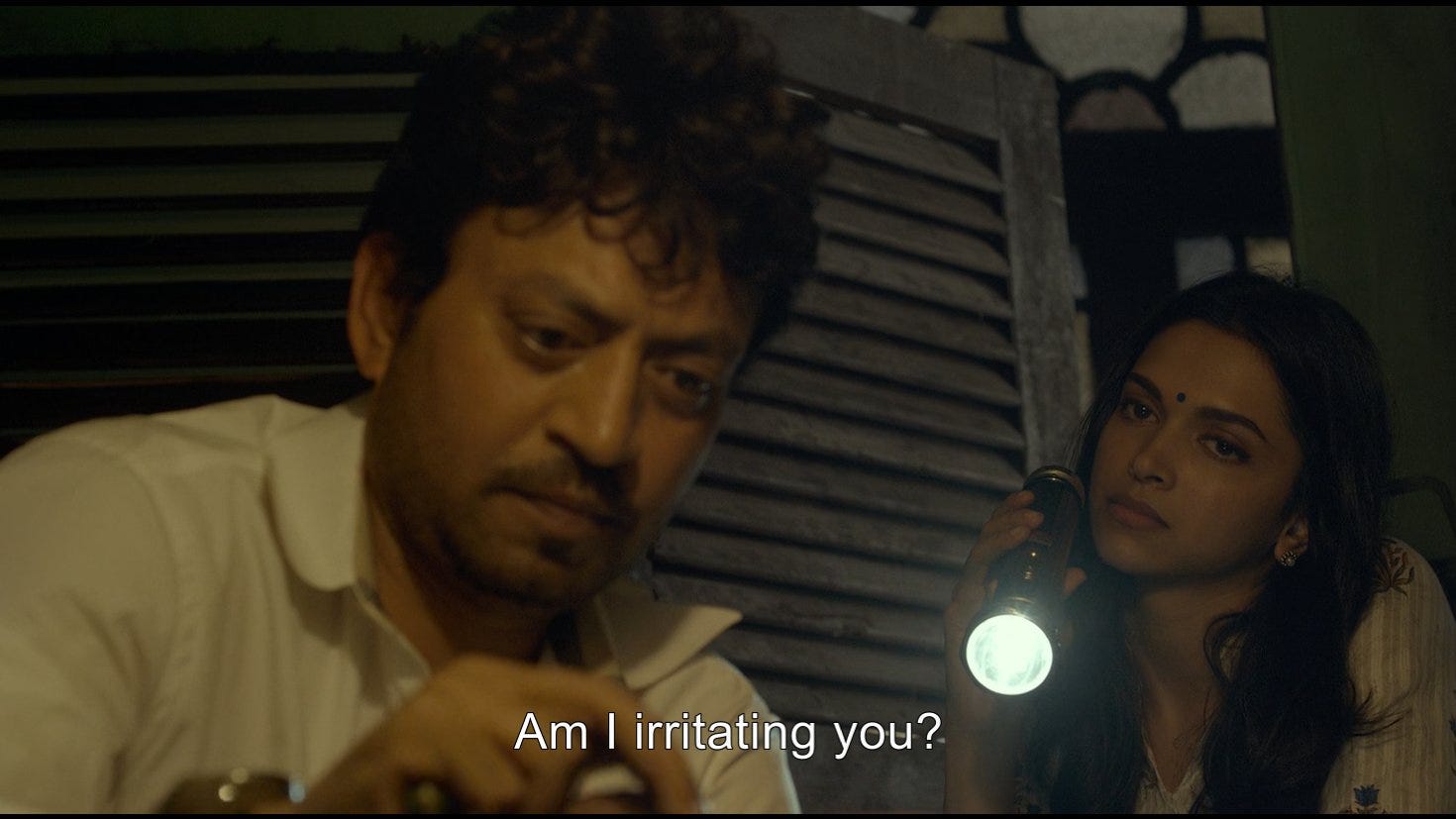
To Piku, taking care of her father is her duty. But to Rana, it isn’t. Rana calls out Bhaskor’s refusal to let Piku get married as selfishness. Bhaskor’s belief is that women whittle away their lives running after their husbands. It was a mistake his wife made and one he wants to make sure Piku doesn’t.
Piku’s active sex life is often thrown in others’ faces, especially suitors, but the film never punishes her for it, a rare feat for a Hindi film. Piku’s romantic interests are left vague and to the audience’s imagination. Her dalliance with Jisshu Sengupta’s Syed is a small subplot, but it creates a safe place for Piku to retreat to when going gets tough.
The editing throughout the film is fast-paced and uneven, with nearly fifteen cuts every thirty seconds. These perfectly emulate the commotion of her life. But when life slows down, Chandrashekar Prajapati’s editing becomes gradual. It’s almost like when Piku slows down to take a beat, we do too. In the second and third acts, as Rana and Piku grow closer, the scenes grow longer, and the fast-paced dialogue reduces its tempo.
Shifting the location from the hustle-bustle of New Delhi to the stillness of Kolkata works wonders for the latter half of the film. Kolkata represents the world Bhaskor seems hell-bent on preserving, as the city seems frozen in time. Kolkata’s sweeping streets and old worn bridges feel neglected. At one point, Piku remarks that there was once a theatre where a building now stands. Rana replies that it is nothing but the natural order of things in the universe. Bhaskor in many ways represents the old theatre, which seems to be replaced by the new world order. Piku originally feels she lacks a connection to the city, but as she walks along the riverbank and visits her late mother’s school, you can see the inherent change in her eyes.
To the audience’s surprise, Piku’s trip doesn’t completely change her. She is still steely-eyed and it doesn’t soften her. It serves as a reminder that Piku isn’t a character that needs to be repaired. She softens and lets her guard down when she thinks she has lost her father, but her stubborn behavior serves as a homage to him.
For a film brimming with commotion, the sound of the sarod forming the foundation of the soundtrack is a curious choice. The sarod traditionally represents the tranquility of life. In a sense, when the Piku Sarod Theme plays, we find Piku’s peace lies in chaos. It plays quietly at the end of each act, symbolizing a change in her character. The sarod beautifully bookends the film when Piku plays badminton with Rana. It’s a change in her idea of peace, from chaos to companionship. An evolution is noticed in her, but as we see her talk to her domestic help in her typical manner, we realize it isn’t at the cost of what sets Piku Banerjee apart.
Throughout its runtime, Piku continues to quietly challenge the status quo. Not just in Bollywood, but in terms of what’s cinematic and what isn’t. Yes, Shah Rukh Khan and Malaika Arora dancing on top of a train in Dil Se.. is totally cinematic. Tom Cruise biking off of a cliff onto a train? I’m all for it. But really, in my mind, there’s nothing more cinematic than depicting regular people going about their regular lives.
And that’s why Piku works so well. It’s why it’s forever inviting. It’s comfortable. But it's also able to emulate and represent Indian women today.
Finding the poetry in your frustration, your monotony, can be life-changing. So maybe next time you’re stuck rearranging your wardrobe, or cleaning the fan, keep the Piku Sarod Theme playing in a corner. It might just be the catalyst for your inner poet to find the words.
You can watch Piku on Sony Liv.
The Sarod theme is always playing in my corner!